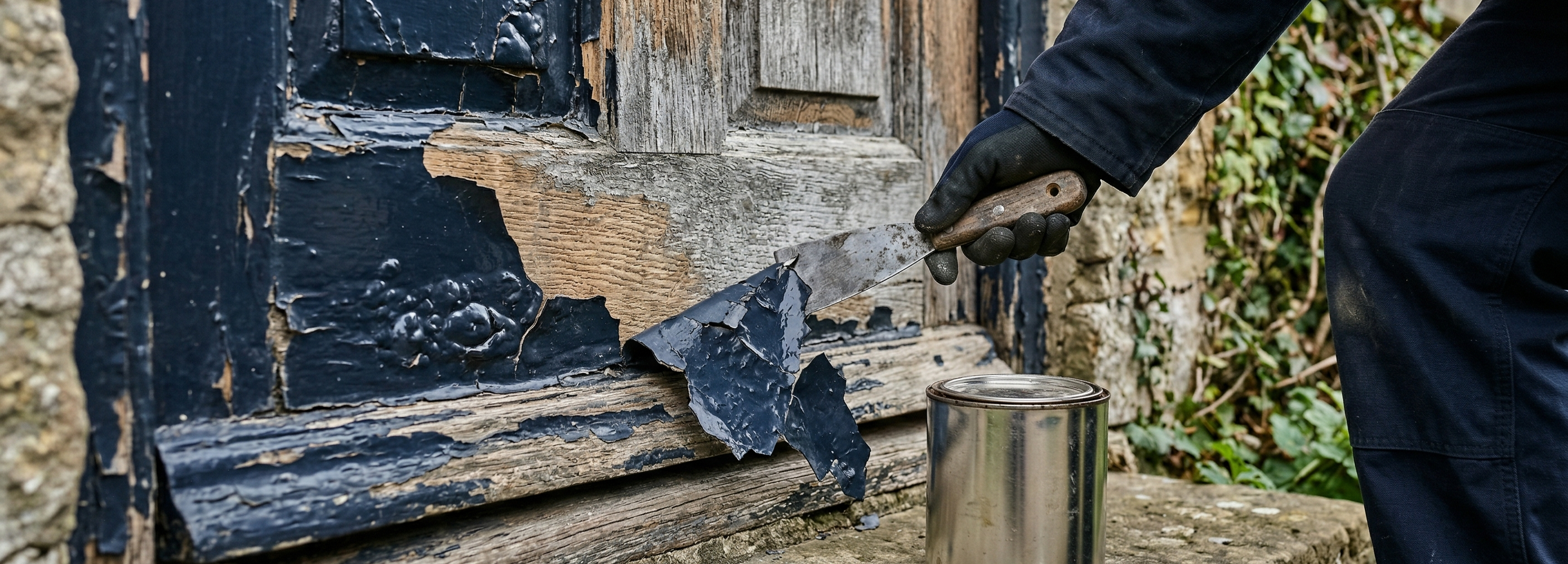
Adhesion failure on wooden substrates is rarely a fault of the paint itself; it is almost always a result of the wood’s natural living characteristics being ignored. Unlike masonry or metal, wood is hygroscopic - it constantly breathes, swells, and shrinks. If the paint is applied to wood with high moisture content, over a degraded grey surface, or onto oily hardwoods without proper degreasing, the bond will snap as soon as the timber moves.
-
Internal Pressure: Trapped moisture in the wood tries to escape as water vapour when the sun hits it, literally blowing the paint film off the surface.
-
Surface Decay: Paint cannot bond to dead wood fibres. It must be sanded back to the bright, living wood to find a structural anchor.
-
Natural Oils: Dense hardwoods like Teak or Iroko contain natural oils that repel water-based and some oil-based coatings unless chemically cleaned first.
→ Shop EverFlor - PolyFlor Timber - Floor Paint for interior wooden floors
The Living Substrate: Why Wood is Different
To understand adhesion failure, you have to understand that wood is a bundle of microscopic straws called fibres. These straws are designed to move water. Even after a tree is cut and turned into a deck or a fence, those straws still react to the environment.
When you apply a coating, you are essentially trying to glue a skin to the ends of these moving straws. If the skin is too brittle, or if the straws are full of water, the bond fails. This is known as inter-coat delamination or substrate failure.
The Top 3 Causes of Wood Adhesion Failure
1. High Moisture Content
This is the single most common cause of peeling wood paint. Wood should typically have a moisture content of less than 18% before coating.
-
The Failure: If you paint wood that is damp (even if it feels dry to the touch), the sun will eventually warm the timber. That moisture turns into vapour, creating internal pressure. Since the vapour cannot pass through a heavy paint film fast enough, it creates a blister and pushes the paint away.
-
The Fix: Use a moisture meter. If it has rained, wait at least 3 to 4 dry days before painting.
2. Lignin Degradation
When wood is left exposed to UV light, the sun breaks down the lignin - the organic glue that holds the wood fibres together. This results in the familiar silver-grey appearance.
-
The Failure: If you paint over grey wood, you are sticking your paint to dead fibres that are already detached from the solid timber below. The paint will look great for a month, then peel off, bringing the grey dust with it.
-
The Fix: Sand the wood back until it is bright (yellow or brown). You must reach the healthy, structural fibres for the paint to anchor.
3. Tannin and Oil Migration
Certain woods, such as Oak, Cedar, and many exotic hardwoods, are rich in tannins or natural oils.
-
The Failure: These oils act as a release agent. Water-based paints will bead up on the surface, while oil-based paints may stay sticky for weeks. Tannins can also bleed through the paint, causing unsightly brown or yellow staining that destroys the aesthetic.
-
The Fix: Wipe the wood down with a strong solvent immediately before priming to strip the surface oils. Use a dedicated tannin-blocking primer to lock the extracts inside the wood.
How to Test Adhesion: The Cross-Hatch Test
If you are worried about an existing coat, or want to check your prep work, perform a simple cross-hatch test:
-
Use a sharp blade to cut a small X or a grid of 1mm squares into the paint, down to the wood.
-
Press a piece of high-tack adhesive tape firmly over the cut.
-
Rip the tape off in one fast motion.
-
The Result: If more than 10% of the paint squares come off on the tape, your adhesion is poor. The entire surface needs to be sanded back before a new coat can be applied.
Honest Trade-offs: Aesthetics vs. Flexibility
Film-Forming vs. Penetrating: Film-forming coatings, like high-gloss paints, offer the best protection against rain but are the most likely to peel because they are stiff and sit on the surface.
-
Penetrating coatings, like oils and stains, are less likely to peel because they live inside the wood fibres, but they require more frequent maintenance.
The Sanding Necessity: There is a common myth that power washing is enough prep for wood. It is not. Power washing actually furs the wood fibres and pushes moisture deeper into the grain. Mechanical sanding is the only way to remove degraded lignin and create the profile required for a long-term bond.
Share:
Why is my Painted Metal Fence Rusting Through the New Paint?