

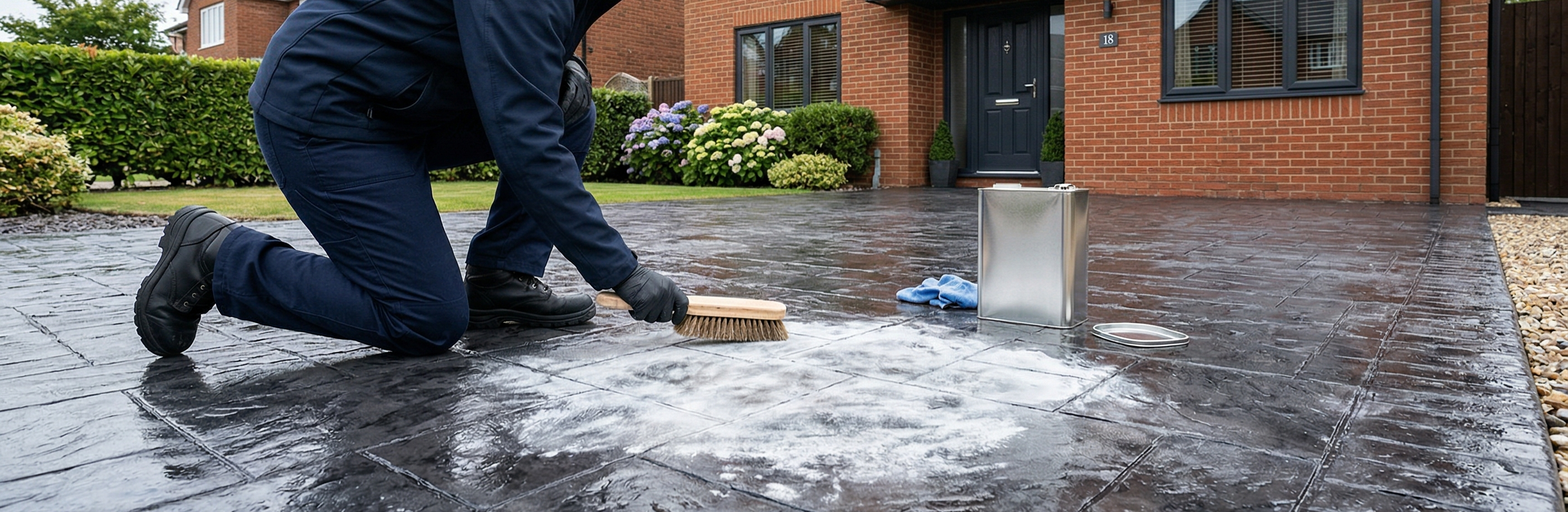
Sealer "bloom" or "blush" is a common technical failure where moisture becomes trapped underneath or within a solvent-based sealer film before it has fully cured. This moisture interferes with the sealer's ability to bond with the concrete, creating a microscopic bubble / gap which reflects light, making the sealer appear cloudy, milky, or white.
To fix it, you must "re-open" the sealer film using a specialized solvent like SummitSeal Sealer Repair Fluid to allow the trapped water vapor to escape before the resin re-sets.
-
The Moisture Trap: Applying sealer to damp concrete or during high humidity (when dew point is reached) causes water to be "sealed in."
-
Optical Distortion: The white color isn't a change in the paint itself; it's light reflecting off the tiny pockets of water and air trapped under the plastic film.
-
The Solvent Fix: Unlike water-based sealers which must be stripped, solvent-based "bloom" can often be cured by "re-melting" the film with xylene.
→ Shop SummitSeal - Sealer Repair Fluid
The Chemistry of the "Blush": Why Does it Turn White?
When you apply a solvent-based sealer, the resin is carried in a solvent (usually Xylene). For the sealer to dry clear and tough, the solvent must evaporate out of the film while the resin molecules "knit together."
If there is moisture in the concrete capillaries - or if it rains shortly after application - the water tries to evaporate upward at the same time the sealer is trying to "skin over." The water gets trapped, preventing the sealer from wetting out the concrete surface. This creates a tiny air/water gap. Because the sealer is no longer in direct contact with the stone, it loses its transparency, and you see a white, "bloomed" patch.
Why Your Sealer "Bloomed": The Main Culprits
1. Damp Concrete
Even if the surface looks dry, the "core" of the concrete might still be holding water from a rainstorm or a pressure wash two days prior. As the sun warms the slab, it pulls that water to the surface, where it hits the bottom of your new sealer film.
2. High Humidity and "Dew Point"
If you seal late in the afternoon, the air temperature drops as the sealer is drying. If the temperature hits the "dew point," microscopic water droplets form on the wet sealer. This water becomes integrated into the resin, causing a milky "blush" throughout the entire coating.
3. Over-Application (Ponding)
Applying the sealer too thick traps the solvent at the bottom of the film. This "solvent entrapment" creates a soft, cloudy layer that never quite hardens and often turns white during the first cold or damp night.
The Solution: How to Use Sealer Repair Fluid
The beauty of solvent-based acrylic sealers is that they are "reversible." Unlike water-based sealers, which are ruined once they turn white, solvent sealers can be "melted" back into a liquid state.
SummitSeal Sealer Repair Fluid is a high-strength xylene solution specifically designed to solve this problem.
Step 1: The "Melt" Pass
Apply the Sealer Repair Fluid liberally over the white, affected areas using a solvent-resistant brush or roller. You aren't trying to add more sealer; you are trying to melt the existing sealer.
Step 2: Vapor Release
As the Repair Fluid dissolves the hardened resin, the "pores" of the sealer film open up. This allows the trapped moisture to finally evaporate into the air. You will often see the white patches disappear almost instantly as the sealer melts down to the concrete, closing the microscopic gaps.
Step 3: Re-Coalescence
Once the moisture has escaped and the Repair Fluid evaporates, the sealer resin will "knit together" again (coalesce). Because the moisture is no longer there to interfere, the sealer will dry clear and bond properly to the substrate.
Honest Trade-offs: When Repair Fluid Isn't Enough
The "Bottom-Up" Problem: If your concrete has a permanent moisture issue (like a failed damp-proof course or a high water table), the bloom will return. Repair Fluid fixes the trapped moisture, but it cannot fix a slab that is constantly "leaking" water from below.
Water-Based Warning: Sealer Repair Fluid only works on solvent-based acrylic sealers. If you have a water-based sealer that has turned white (usually due to "creaming" or failed coalescence), xylene will not fix it. In those cases, the only solution is usually mechanical or chemical stripping.
Timing is Everything: Try to use the Repair Fluid during the warmest, driest part of the day. If you use it in the evening, you risk trapping more moisture as the dew falls, potentially making the problem worse.
Share:
Do You Need to Remove Efflorescence Before Applying Sealers? White Salt on Block Paving